VERGE Panel Recap
Fire architects wanted: who gets to shape the systems we depend on?
What a VERGE panel in Stockholm taught us about resilience, teams and the open door into cybersecurity.
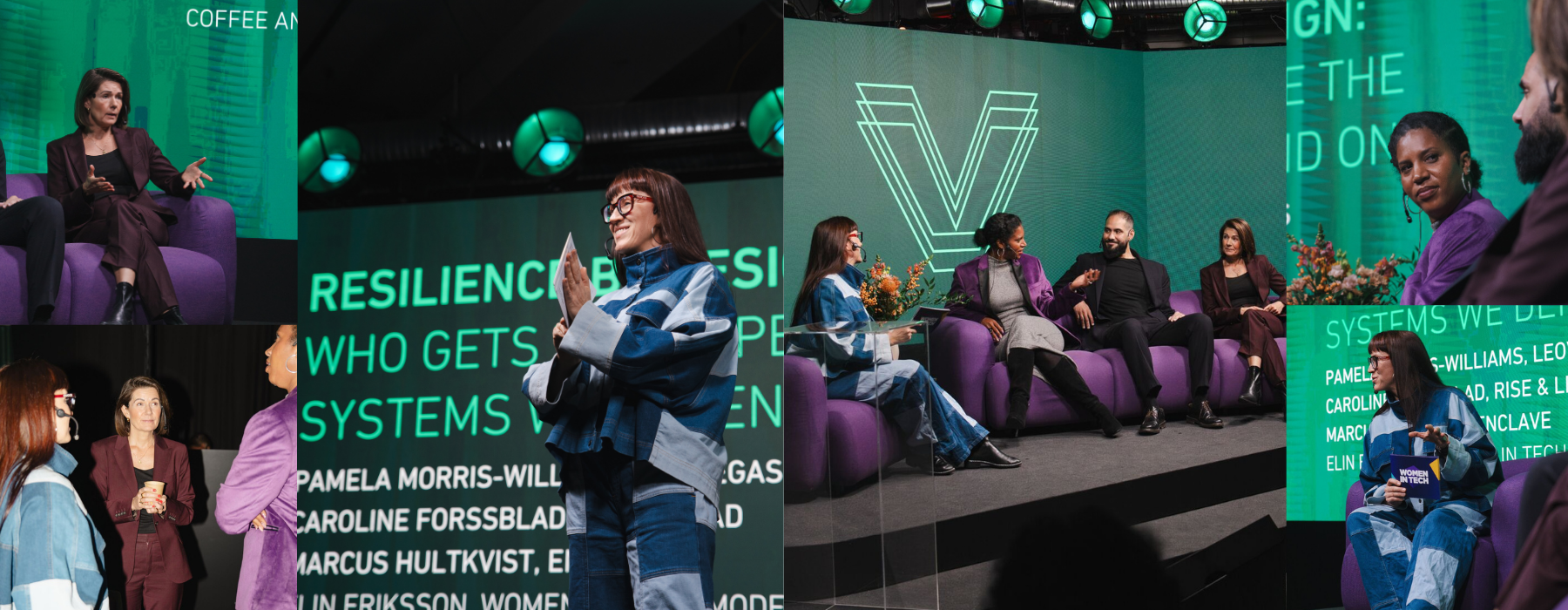
On Monday 19 October, Women in Tech Sweden took part in VERGE: Comprehensive Security, hosted by Epicenter in Stockholm. Our co-founder Elin Eriksson moderated a panel built around one question: who decides how the systems we all depend on are built, and who needs to be in the room when they are?
She had three vantage points on stage. Caroline Forssblad of Rise & Lead has more than 20 years of experience advising chief executives and security leaders. Marcus Hultkvist of Enclave builds on-premises artificial intelligence (AI) infrastructure. Pamela Morris Williams of LeoVegas runs security and compliance in gaming and betting, one of the most regulated and most targeted industries there is.
From firefighters to fire architects
Caroline described how too many security teams need to act as firefighters. They are brought in late, left out of early decisions and then asked to put out fires that, if better designed, could have been prevented.
The cost lands on people, since security leaders can end up tired and unseen when flawless work means that nothing happens. Her advice was to do the inner work, accept that nobody controls everything and hand over risk when that is the right call. Her image for security and business working well together was a tango, where both partners understand the vision, the strategy and where the money comes from.
Threats move faster than law
Pamela pointed out that changing a regulation can take around three years, while the threat landscape keeps shifting. Her answer was to find allies. Silos leave everyone more exposed, and some of her best insights have come from people in entirely different industries.
Simplicity is resilience
Marcus offered two principles. Know your dependencies, because control over your data ends where visibility ends. Keep it simple, so that critical processes never rely on special know-how, everything is documented and a failing component can be replaced by another.
The team you need
All three described a mix: people with deep technical skill, translators who can explain to a board why something needs investment, and a range of perspectives, including someone who looks ahead to innovation and business development. Pamela added an honest starting point: look at what your company needs and build from there.
The open door
This is where our work meets the panel. Marcus teaches junior security talent every year and said the industry is still not welcoming enough to women, even though many of his strongest students are women. He also noted that few Swedish security companies run trainee programmes, so juniors rarely get a first chance. Caroline said role models should share the whole story, including the hard parts, and that mentorship and networks can work like a sisterhood that makes the first step easier. Networks, role models and inspiration are the three pillars Women in Tech Sweden builds on every day.
The numbers show the room for growth. According to the 2025 workforce study from ISC2 (the International Information System Security Certification Consortium), women make up about 22 percent of the global cybersecurity workforce.
Try this on Monday
- Bring security in at the design stage of your next project, well before launch.
- Map who in your team goes deep technically and who can speak to the board.
- Open at least one junior or trainee role in security.
Elin closed the session with the idea that resilience gets designed in from the start. Who sits at the design table decides what gets designed.
Thank you to Epicenter for the stage, and to Caroline, Marcus and Pamela for an open and generous conversation.
Read Epicenter’s own recap of the panel for more.