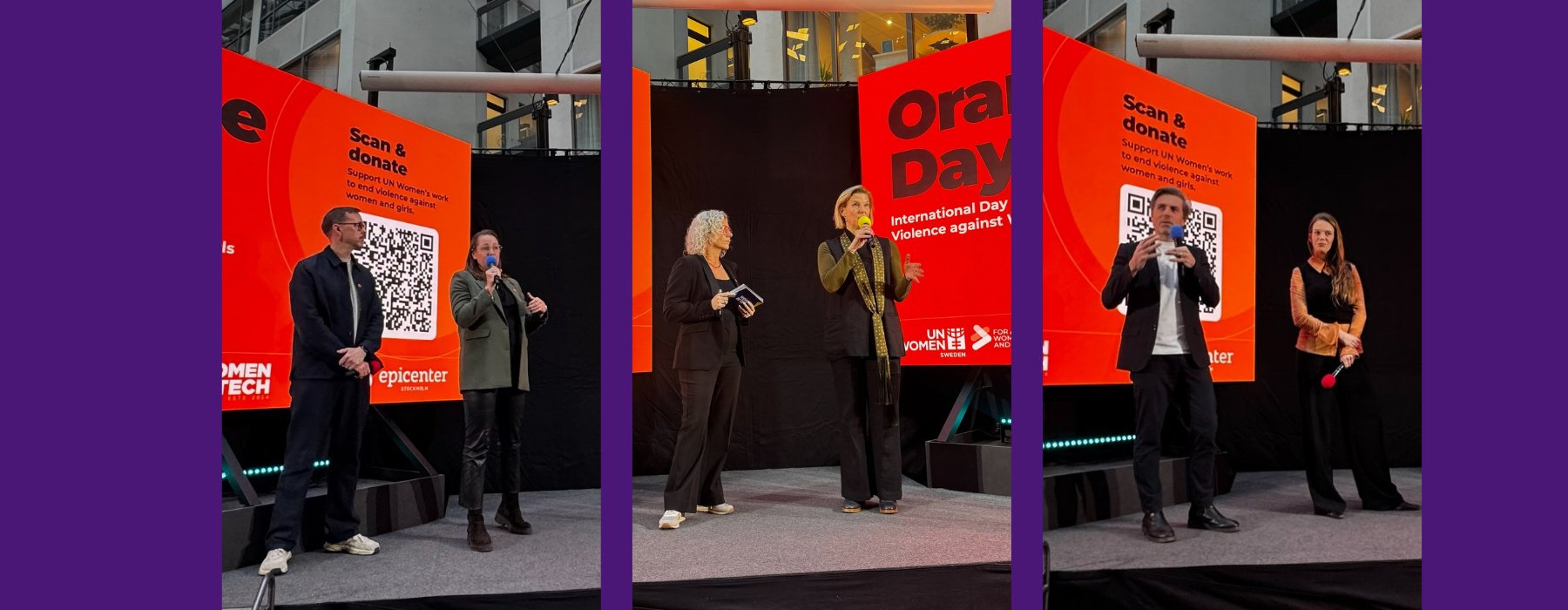
Threats and harassment online push women out of public life, and employers must treat these issues as the work environment problems they are. That was the message from Nina Larsson, Minister for Gender Equality, at the Orange Breakfast in Stockholm on 25 November, hosted by Women in Tech Sweden, UN Women Sweden and Epicenter Stockholm.
Minister Nina Larsson opened the morning in conversation with Åsa Johansen, Director of Women in Tech Sweden. Digital violence drives people out of public life in every profession, she said, and in Sweden women journalists live with personal protection. “We must remove the obstacles that make people choose to opt out,” Larsson said. “It is an enormous loss for all of us.”
Asked what employees can expect from their employer, she answered: “To take it extremely seriously and have systematic handling when it happens.” The Work Environment Act (arbetsmiljölagstiftningen) is crystal clear, she said, yet threats and sexual harassment are not valued as the serious work environment problems they are. Individuals can act too. A spring report from the Swedish Defence Research Agency (FOI) shows that speaking up in online comment fields helps both the person targeted and everyone reading.
The Kvinnofrid inquiry, presented in early September with Minister for Justice Gunnar Strömmer, covers the digital dimension and could take up to two years. “Harassment, threats, hate and violence against women are unacceptable and must stop,” Larsson said. “And we do not intend to stop until we are there.”
Louise Waller of UN Women Sweden, the Swedish arm of the United Nations body for gender equality, explained why November is orange: the colour stands for “a bright and optimistic future, free from violence against women and girls.” The numbers behind it are hard. “One in three women has at some point in her life been subjected to physical and/or sexual violence,” Waller said. “One in three.”
When UN Women and Women in Tech Sweden asked the team at Epicenter Stockholm if they wanted to co-host the Orange Breakfast, the reply was fast and affirmative. Adrian McDonald, CEO of Epicenter Group said “This is something that has to be on the agenda. Being reminded of the numbers, and of how violence affects workplaces, matters.”
Åsa Johansen added that having the breakfast seminar here at the very heart of the innovation hub, with an audience of both men and women is a way to bring the conversation to the people who build the technology and lead the companies of the future.
Beyond the policy
Further on in the program, Hanna Eidem, Director of Tjejzonen, described three levels of responsibility for workplaces. Policies and action plans are the first level, and they are great once something has happened, she said, but she wanted the room to look further upstream. “You can write it in policies, but that’s not where it happens,” Eidem said.
The second level is the civil courage of colleagues in everyday situations. The third belongs to everyone who builds technology. Eidem urged the tech industry to ask the hard questions when designing new products: “How does this affect young people? What effect does it have on a 12-year-old? Or does this function make violence possible within the service?”
Many people see violence in close relationships as a private matter. Markus Antonsson, lecturer and former police officer, put it on the company risk agenda. When he spoke about the subject at a security trade fair, he said, nobody had raised it there before. “We have perpetrators who get hold of trade secrets, data, classified information,” Antonsson said. “And the security industry has no idea about this, which is surprising, since it is so common.”
The link to technology came up again from the audience. Patrik Nylander, CEO of Accenture Sweden said their lead for cybersecurity was in the room, and that colleagues have combined deep knowledge about these issues with information security expertise, which has resulted in concrete solutions.
Patrik Nylander said several channels to turn to are needed, including human resources, the legal team and an anonymised Business Ethics Line. Culture matters even more than process, he said: “It is first and foremost about listening.”
People may also hesitate to speak up when the incident involves a client, he added, afraid of coming across as a difficult colleague who harms the company. Accenture has concrete examples of it happening. “When we have raised it with client companies, it hasn’t been seen as a problem,” Nylander said. “On the contrary, it has strengthened our relationship.”
Nylander was one of two guests from the audience, not announced as speakers, who shared how they work. Lukasz Lindell, Senior Policy Communications Lead, Nordics & European Infrastructure at TikTok, said policies and training are the foundation. He also stressed that speaking up when other men behave inappropriately, must be “necessary – not voluntary”. TikTok has an external speak-up channel open to customers and partners.
Åsa Johansen closed the morning by asking everyone to leave with one insight: “Terrible things happen in our digital work environment. But we can do something to stop it.”
Thank you to Epicenter for making it possible for Women in Tech Sweden and UN Women Sweden to host the breakfast.
5 practical things to do when someone at work is subjected to digital violence.
Hanna Eidem, Director of Tjejzonen, and Markus Antonsson gave the room practical advice and things to think about before you approach to help a colleague.